
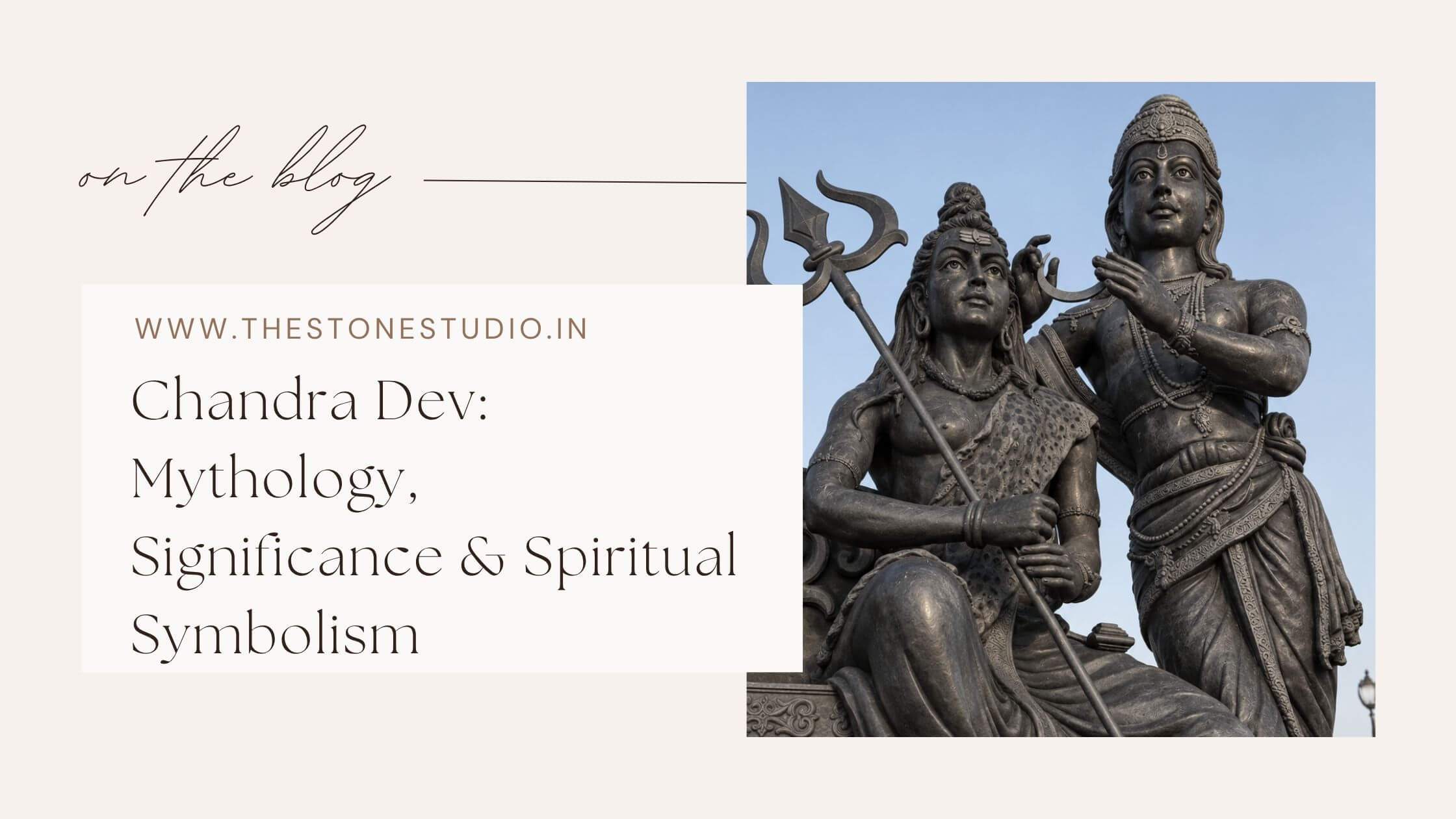
Chandra Dev: Significance & Symbolism
Table of Contents
Chandra Dev: Significance & Symbolism
Look up at the night sky on a full moon evening, and you will understand why ancient India saw divinity in the moon.
The soft silver light soaking a quiet courtyard, the peaceful pull of tides, the mysterious way moonlight touches the nature differently than sunlight — none of this, the ancient Hindu visionaries said, was coincidence – it was Chandra Dev. The sacred moon god. The celestial ruler of the night sky, of the mind, of emotions, and of time itself.
In Hinduism, the moon is not merely a celestial body — it is a living, breathing deity whose mythology is among the richest and most emotionally echoing in all of Hindu tradition. Understanding Chandra Dev — who he is, what he represents, and his symbolism — opens a window into one of India’s most profound and beautiful spiritual traditions.
Who is Chandra Dev?
Chandra Dev — also known as Soma, Indu, Shashin, and Chandrama — is the Hindu god of the moon and one of the Navagrahas (the nine celestial bodies controlling human fate in Vedic astrology).

He is depicted as a handsome young god — fair-complexioned, serene-faced, and radiant — riding a silver chariot drawn by ten white horses across the night sky. He holds a lotus flower and unravels a crescent moon as his crown. His entire form glows with soft, silvery luminosity, describing the gentle, nourishing light he radiates upon the world.
As Soma, he is also the presiding deity of the heavenly soma drink — the divine nectar used in Vedic rituals, believed to grant immortality and elevated spiritual consciousness. This dual uniqueness as both moon god and lord of the sacred soma gives Chandra Dev an extremely rich importance spanning astronomy, ritual, medicine, and mythology.
The Story of the Birth of Chandra Dev
We can find various stories about the birth of Lord Chandra. Here are two of the most significant and interesting tales that everyone should know when seeking the Lord’s story.
Chandra Dev As the Son of the Sage Atri
The first origin story, found in the Vishnu Purana and other texts, describes Chandra Dev as the son of the great sage Atri and his wife Anasuya. In this version, the three supreme gods — Brahma, Vishnu, and Shiva — incarnated as children of Atri, with Chandra denoting the form of Brahma. From his eyes, it is said, the moon was born — and with it, all the cooling, nourishing energy that moonlight brings to the world.
According to the Puranas, Chandra Dev appeared during the great Samudra Manthan — the cosmic churning of the primordial ocean of milk. The gods and demons churned the ocean using Mount Mandara as the churning rod and the serpent Vasuki as the rope, fourteen divine treasures rose from the depths. Among them was Chandra Dev — radiant, serene, and instantly claimed by Lord Shiva, who placed the crescent moon upon his matted locks, where it remains as his most iconic ornament to this day.

This origin story proves Chandra Dev’s incredible significance immediately — he is not a minor deity but a gem of the cosmos itself, born from the most sacred act of creation in Hindu mythology.
Why does the moon grow and shrink every month?
Of all the stories encircling Chandra Dev, none is more humanising, more surprising, or more beautifully descriptive than the one that answers a question every child eventually asks: Why does the moon grow and shrink every month?
Chandra Dev was married to the 27 Nakshatras — the 27 daughters of the great ancestor Daksha Prajapati, each depicting one of the 27 lunar mansions through which the moon passes during its monthly journey. The marriage was a cosmic arrangement of divine balance.
But Chandra Dev had a favourite.
Among all his 27 wives, he was utterly and helplessly devoted to Rohini — the most beautiful of them all. He spent all his time with Rohini, showering her with attention and divine light, while his other 26 wives lived in quiet, heartbroken neglect.
The ignored wives went to their father Daksha in tears. Daksha — a figure of extreme principle and spiritual authority — appealed to Chandra Dev three times to treat all his wives with equal love and devotion. Chandra Dev listened respectfully each time.
And continued to favour Rohini as before.
His patience finally drained, Daksha pronounced a horrible curse: “You shall suffer from Kshaya Roga — the wasting disease. You will diminish, day by day, until you vanish entirely.”

The moon began to shrink. Day by day, his light dimmed and his form thinned. The world observed in alarm. Crops began to fail. The tides grew unsettled. The divine soma nectar — of which Chandra was the keeper — began to finish. The gods grew anxious.
In desperation, Chandra Dev sought Lord Brahma, who directed him to worship Lord Shiva at the sacred Somnath Jyotirlinga on the western coast of India. For six months, Chandra Dev performed intense penance there, chanting the Maha Mrityunjaya Mantra 108 times each day with unwavering devotion.
Lord Shiva — moved by the moon god’s genuine repentance and sincerity — appeared before him. The curse of Daksha could not be entirely undone, Shiva explained, but it could be moderated:
For fifteen days, you shall grow — waxing to full brilliance. For the next fifteen days, you shall wane — diminishing toward darkness. And then the cycle shall begin again, forever.
This is why the moon waxes and wanes to this day — eternally carrying within its monthly rhythm the story of pride, punishment, devotion, and divine mercy.
And Somnath — the Jyotirlinga where Chandra found his redemption — literally means “Lord of the Moon.” It remains one of the twelve sacred Jyotirlingas of Lord Shiva and one of India’s most revered pilgrimage destinations.
Head over to The Stone Studio to explore our stunning range of Hindu God statues, expertly crafted to enhance the beauty of your home and garden!
www.thestonestudio.in
Download Our Free Brochure Here!
Chandra Dev and Lord Shiva — The Moon on the Matted Locks
Of all Chandra Dev’s divine connections, none is more spiritually significant than his bond with Lord Shiva.
As Chandra Dev emerged from the churning of the cosmic ocean, Shiva claimed him at once, setting the crescent moon upon his tangled locks, where it has gleamed ever since. In every depiction of Shiva, the crescent moon is woven into his very being, as vital as the trishul or the third eye.
The symbolism runs deep. Shiva — lord of time and celestial dissolution — wears the moon, which governs the passage of time through its cycles, as his crown. The moon’s cooling, soothing light counterbalances Shiva’s fierce energy. In the Shiva Sahasranama, Lord Shiva is addressed as Chandrashekhara — “he who wears the moon as his crest” — one of his most beloved names and the subject of countless hymns.

When you place a Shiva murti in your home, you are also honouring Chandra Dev — whose crescent form rests eternally upon the Mahadeva’s brow.
Significance & Spiritual Symbolism of Chandra Dev
- Chandra Dev, known as the Moon God in Hindu tradition, represents calmness, peace, and emotional balance.
- Unlike Surya Dev, the Sun God, who symbolizes brightness and action, Chandra Dev is all about gentleness and tranquility.
- The moon’s soft light reminds us that we can find clarity even during tough times, without any harshness.

- Chandra Dev is also connected to our feelings and thoughts. Just like the moon changes phases, our emotions and life experiences do too.
- His teachings encourage us to be patient and accepting as we go through different stages of life.
- In Vedic astrology, Chandra is linked to our mind, memories, imagination, and emotional well-being.
- A peaceful Chandra is believed to promote mental calmness, compassion, and clear thinking.
- He embodies healing and renewal, with moonlight often seen as soothing and spiritual.
- This makes Chandra Dev a comforting symbol for emotional healing. In art and sculptures, Chandra Dev is usually shown with a crescent moon, a peaceful expression, and beautiful clothing.
- You might see his sculptures in temples, meditation spaces, spiritual gardens, and even in home decorations.
- Owning a piece that represents Chandra Dev can bring a calming and beautiful atmosphere to any space.
- When creating a handcrafted sculpture of Chandra Dev, artists often focus on gentle facial features, elegant poses, and moon-themed designs. Ultimately, he represents the strength that comes from peace, intuition, and emotional harmony, reminding us of the quiet power within us all.
Chandra Dev Sculptures — Bringing the Moon God Home
A handcrafted Chandra Dev sculpture in your home is far more than a decorative piece. It is a daily, silent invitation to the moon god’s cooling, calming, and nourishing energy — believed to calm the mind, enhance emotional wellbeing, strengthen intuition, and invite clarity into the space it inhabits.

A Chandra Dev murti is particularly meaningful in:
- Meditation and puja rooms — where his calming energy deepens spiritual practice
- Study spaces — where his governance of the mind enhances clarity and focus
- Bedroom or personal altar — where his soothing presence supports restful sleep and emotional balance
- Living rooms — as a serene, culturally rich centrepiece that invites peace into the home
Frequently Asked Questions (FAQs)
1. Who is Chandra Dev and why is he important?
Chandra Dev is the Hindu god of the moon. He plays a significant role in Vedic astrology as one of the nine celestial beings, known as Navagrahas, that influence our lives. Chandra Dev is associated with our thoughts, feelings, and intuition, as well as the way time flows through the lunar cycles. This makes him a key figure in understanding our everyday experiences and well-being.
2. Why does the moon wax and wane according to Hindu mythology?
According to Hindu mythology, the moon goes through phases of getting bigger (waxing) and smaller (waning) because of a curse placed on Chandra Dev. This curse came from Daksha, who was upset that Chandra Dev favored one of his 27 wives, Rohini, over the others. To ease the situation, Lord Shiva intervened, allowing the moon to grow for fifteen days and then shrink for the next fifteen days, creating a continuous cycle that explains the phases of the moon we see today.
3. What is the connection between Chandra Dev and Lord Shiva?

Chandra Dev, the moon god, is closely linked to Lord Shiva, who is often depicted wearing a crescent moon in his hair. This gives him the name Chandrashekhara, meaning “the one who wears the moon on his head.” According to stories, when Chandra Dev was troubled by a curse from Daksha, he prayed at a sacred place called Somnath. Lord Shiva helped him by placing him on his head, making Chandra Dev a symbol of mercy and devotion.
4. What day and mantra are best for worshipping Chandra Dev?
Monday, known as Somavar, is considered the most auspicious day for honoring Chandra Dev. A powerful prayer known as the Chandra Beej Mantra is often chanted on this day. It goes: “Om Shraam Shreem Shraum Sah Chandraaya Namah.” Reciting this mantra 108 times on Monday mornings is said to bring mental clarity, emotional balance, and blessings from the moon god.
5. Can you keep a Chandra Dev sculpture at home?

Yes, having a Chandra Dev sculpture at home is believed to be very lucky, especially in places meant for prayer, meditation, garden or study. The calm and soothing energy of Chandra Dev helps to clear the mind and promote emotional balance. At The Stone Studio, we create beautiful Chandra Dev sculptures from materials like black stone, sandstone, fibre, wood, and marble, each intricately crafted with care and devotion.
6. What gemstone is linked to Chandra Dev?
The pearl, known as Moti, is the gemstone associated with Chandra Dev. Wearing a natural pearl in a silver ring on your little finger on a Monday morning, after checking with an astrologer, is thought to enhance the positive qualities of the Moon. This can improve emotional stability and boost creativity.
Chandra Dev is more than a deity of the night sky. He is a god of the inner world — governing the mind, the emotions, and the quiet rhythms of human experience that mirror the moon’s own eternal cycles of light and shadow.

His mythology is rich, his symbolism is profound, and his presence in Hindu tradition touches everything — from the Vedic rituals of ancient India to the daily prayers of millions of devotees across the world today. Whether you know him as Chandra, as Soma, or simply as the beautiful silver light that fills your room on a full moon night — his blessings are ever present, ever gentle, and ever nourishing.
Understanding Chandra Dev — his stories, his significance, and his symbolism — deepens not only our appreciation of Hindu tradition but our relationship with the natural rhythms of our own inner lives.
At The Stone Studio, we handcraft Chandra Dev and Navagraha sculptures in black stone, sandstone, fibre, wood, and marble — each piece individually carved by our artisans, with devotion and iconographic precision. If you are looking to bring the moon god’s calming, nourishing presence into your home or sacred space, we would be honoured to craft that piece for you.

Explore The Stone Studio’s unique collections to get a customized Moon God Statue or your personal Altars & Home Temple!


